Since last year, Ivan has been learning Yunka Dene – the local Indigenous language of the Stella'en peoples. Ivan’s efforts are helping him to better communicate and build bonds with his patients of the Stellat’en First Nation, located just outside Fraser Lake.
"They are really respectful of the fact that I’m trying to learn their language," Ivan says. "It brings them joy. They laugh when I mess something up, but then they teach me."
Stellat'en First Nation (No. 613) is located on the banks of the Nadleh Bun (Fraser Lake), near Fort Fraser, B.C. Yunka dene, meaning 'the people of the land', is part of the Athabaskan language family. Stellat'en and neighbouring communities speak distinct dialects.
This language family, which also includes Chilcotin and others in BC, is considered by many linguists to be among the hardest in the world to learn. How a verb is formed changes depending on the number of people, tense, whether an action is completed, and whether it's routine, ceremonial, or one-time.
This complexity makes Ivan's journey even more impressive.
When Ivan first began visiting patients at Stellat'en First Nation, health director Cynthia Munger handed him a language dictionary and teased: "If you’re going to visit Elders, you'd better start learning the language".
Ivan recalls thinking to himself: "There’s no reason I can't learn how to say 'hello' and other conversational terms."
As he started visiting Elders, they began teaching him greetings: how to say hello and, in the absence of the word 'goodbye' in the Yunka dene language, how to tell someone "I will see you again." Over time, the lessons grew.
"Once I had learned those kinds of things, they started teaching me more and more medical terms," Ivan remembers.
When Ivan learned about a language program at the Nicola Valley Institute of Technology to learn Yunka Dene, he was intrigued.
"They had 60 seats for the program," Ivan says. "It was outside of my work hours, so I went to the department and asked if I could be part of the program. I told them I would pay for tuition and use my own computer."
Ivan was admitted to the program as the 61st student and started his studies in October 2024. Classes run twice per week throughout the regular school term.
For Ivan, the impact of learning the language has been immediate.
"Because I am taking the time and making the effort to learn, it instantly builds a rapport," he says.
Ivan attends a regular elder’s tea, where he takes everyone’'s vitals: blood pressure, heart rate, and oxygen levels. He then tells everyone their numbers in Yunka Dene.
Yunka Dene words often carry more than one meaning. One example Ivan provides illustrates both the complexity and the beauty of the language.
"To say 'my sister' – my sister is 'sulhtuc', but it also means strength. So, depending on how you use it in the sentence, when you say my sister as a noun, you are saying 'my strength.'"
Ivan began his BCEHS career six years ago as a primary care paramedic, moving into the community paramedic role just three months later.
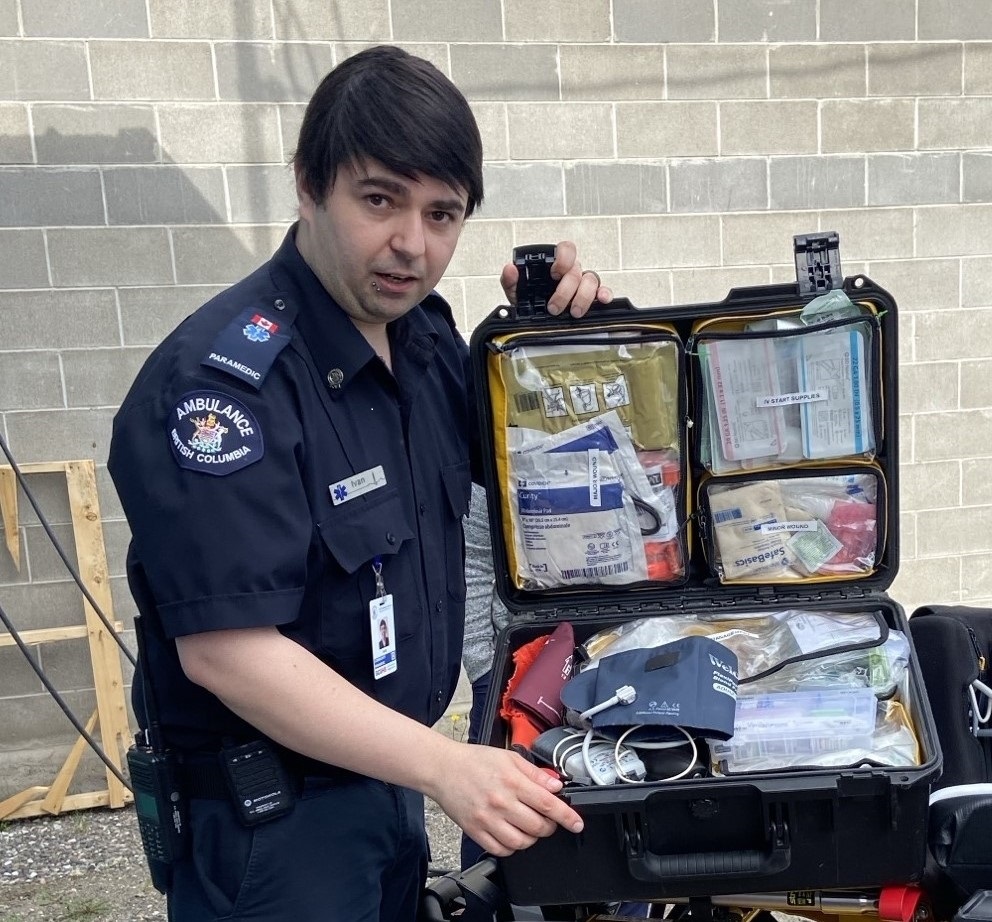
"Emergency care [is] seeing people on their worst days. As a community paramedic, it's being part of their primary care. We establish a rapport with the client through multiple visits. We kind of develop a friendship with them, honestly," Ivan explains. "What else is really nice about it is we get to see their successes. When things go well, we get to see that side of it, too."
Currently, Ivan sees about 19 clients across Stellat'en, Nadleh Whut'en, and nearby communities, with his patient numbers fluctuating as people graduate from the program.
Over the years, Ivan has been invited to a variety of cultural events at the Stellat'en First Nation — Bahlats (potlatches), ceremonies, and community gatherings. When he's not working, he often brings guitar and plays music at the events – a hobby he has pursued since the age of 12.
"As I've learned more and more language, I get invited to more and more cultural events," Ivan explains. "The culture is also embedded in their language. Just by learning the language, you tend to learn a lot about the culture."
"When Ivan Hayward first came to Stellat'en First Nation I gave him our language dictionary, and told him teasingly to start learning it if he wants to work with our Elders," says health director at the Stellat'en First Nation Cynthia Munger. "Ivan took the dictionary and began to learn the language on his own. He practices with our Elders when he does home visits. The Elders enjoy his visits and getting a chance to practice and teach the language to him. Ivan is very attentive to the Elders, and the care he provides them is a true example of holistic primary care. Stellat’en First Nation loves and appreciates Ivan — he is part of our family."
Ivan continues to attend language classes twice a week during the school year, and practices Yunka Dene whenever he sees his patients.
"As much as I can, I have conversations in the language. I use the language as much as possible when I do wellness checks. Every time I go out to the community, I try to pick up another word or two," he says. "The best way to learn a language is to speak it."
"The people I speak with appreciate it so much. They're so grateful," Ivan continues. "It's funny – I even got asked to go play some songs at a camp in Fort. St James the other day. People's head turned because this white guy comes in and I'm speaking to them in Yunka Dene."
Ivan's passion for patient care, wellness, and going the extra mile to build meaningful relationships makes him an invaluable member of the community paramedic team and program. Director of community paramedicine Amy Poll is quick to sing Ivan's praises:
"Ivan is a remarkable community paramedic whose dedication to patient care and cultural understanding is inspiring,” she says. "His efforts to connect with the Stellat'en First Nation and empower individuals truly reflect the heart of the Community Paramedicine Program. Ivan is a mentor, a compassionate caregiver, and a powerful example of how we can help people help themselves."
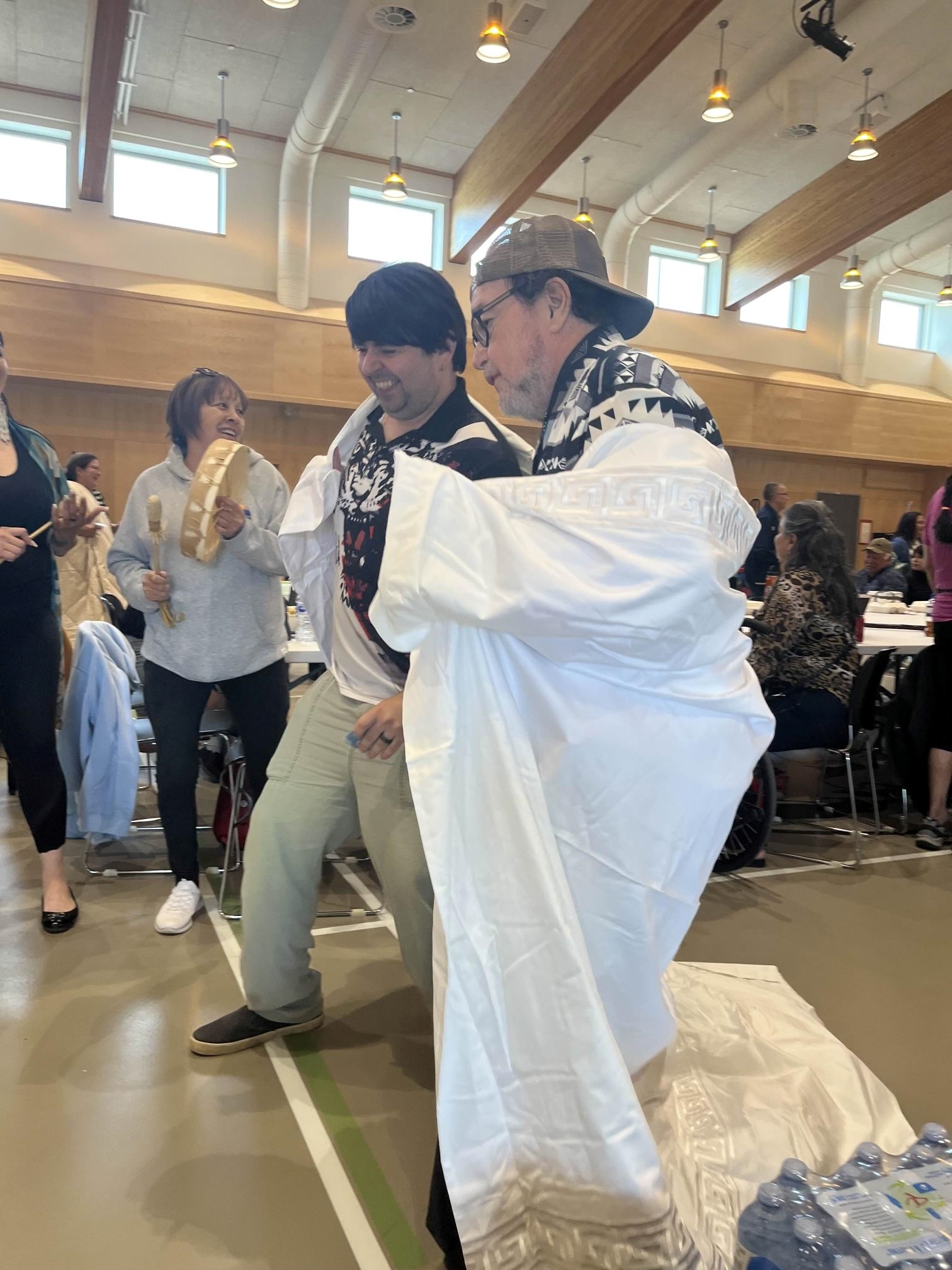
Ivan with his friend George George Jr. at a funeral bahlat in Nadleh Whut-en on June 15, 2025