In a province as big as BC - almost a million square kilometres, more than France and Germany combined – moving patients by air isn’t just about speed and convenience, it’s a necessity. BCEHS has 15 dedicated air ambulances, including nine airplanes and six helicopters, but the heart of the BCEHS air program isn’t the aircraft, it’s the people. Paramedics make air transport possible by providing medical care for patients in confined aircraft cabins and keeping them safe, stable and comfortable while in transit.
The first advanced care and primary care flight paramedics entered service earlier this year and are now working at BCEHS stations based in Vancouver International Airport, BC Children’s Hospital, Prince George, Kelowna and Fort St. John. There are plans to station advanced care and primary care flight care paramedics in Prince Rupert, and they will begin training soon.
These flight paramedic roles are increasing capacity for medical air transport in BC and helping to ensure patients get the best care possible when they need to be moved by aircraft.
“There are tons of pros around this from a patient perspective where we’ll move patients more efficiently, more effectively,” says director of clinical practice and interim director of flight operations Rob Schlamp.
“We think it’s a win-win all around: its patient centered, a paramedic profession win, and we’re creating two new designations that are much more highly trained.”
Prior to the introduction of the first cohorts of primary care and advanced care flight paramedics earlier this year, critical care paramedics and members of the Infant Transport Team typically cared for patients being moved by air.
Critical care paramedics have the highest level of paramedic training, with specialized skills for caring for the most critically ill and injured patients. Infant Transport Team paramedics are critical care paramedics with additional training focused on caring for infants, children and high-risk maternity patients.
Critical care paramedics are experts at treating the very sickest patients, but not all patients require the level of care they’re able to provide.
“When we looked at data, there are a significant number of calls where we were sending the Infant Transport Team and critical care paramedics to patients who could have received the care they needed from advanced care paramedics or primary care paramedics,” says Rob Schlamp. “We want critical care paramedics to be held in reserve for the high acuity, complex, time-sensitive calls that they’re specifically trained to manage.”
The paramedics who go through flight training are also getting an opportunity to grow professionally and expand their clinical skill set.
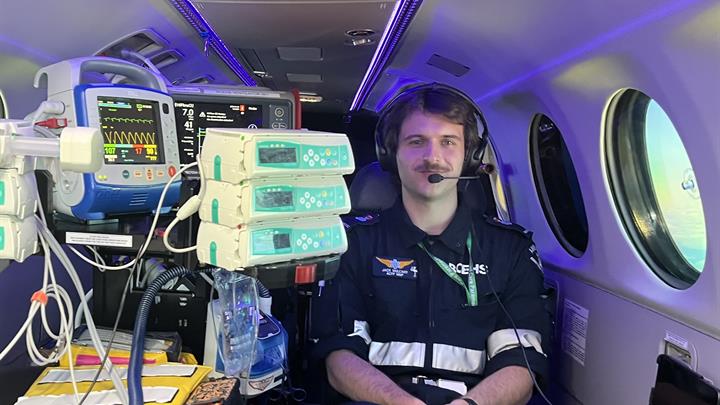
“A lot of people don’t realize that there’s different levels of paramedics,” says advanced care flight paramedic Jack Mulcahy (pictured above), who is based in Prince George. “As one's schooling increases, so does the level of skills and services they provide, often mirroring the same treatments as leading emergency departments and intensive care units. A lot of people think of the classic ‘ambulance driver’ stereotype but all the paramedics in our organization can autonomously provide a high level of medical care and this continues to expand with these new flight programs.”
In addition to the training they’ve already received to become licensed as paramedics, primary care and advanced care flight paramedics receive eight months of specialized training where they learn about the unique challenges of treating patients on air ambulances, as well as safety skills specific to their new workplace.
“During the first week we did the helicopter underwater escape training,” says Bobby Currie, a primary care flight paramedic based in Vancouver. “We went out to the pool in Langley and spent the day learning how to get out of a helicopter in the event of a water landing. They literally flip you upside down underwater, blindfolded in a cage – so that was pretty intense.”
They also learn and practice specific clinical skills that advanced care paramedics and primary care paramedics are licensed to do but are outside the typical scope of practice for paramedics in BC.
“With this program we’ll be able to give many medications under the direction of a doctor,” says Keira Evans, a primary care flight paramedic based in Prince George. “Before, only critical care paramedics could do that, even if these transfer patients didn’t have acute medical needs. Now that primary care paramedics can run medications, we’ll be able to care for lower acuity patients who need medication administered during transport, and we’ll reduce waiting times for acute patients that require a higher level of care.”
Most of the flight paramedics currently working in BC specialize in caring for a special and specific group of patients: newborns, children and maternity patients.
Across BC’s vast geography, only certain hospitals have specialized facilities and staff dedicated to caring for neonatal, pediatric and maternity patients when they’re facing serious health problems. Ensuring these patients can be moved quickly and safely to the hospitals best equipped to care for them is a crucial job and one that has historically been performed by the BCEHS Infant Transport Team. Until recently, only critical care paramedics were part of the Infant Transport Team, but now primary care and advanced care flight paramedics are part of this important work.
The primary care flight paramedics and advanced care flight paramedics who work with the Infant Transport Team have additional training that focuses on treating neonatal, pediatric and maternity patients, including a clinical rotation at BC Children’s Hospital. They are based at BCEHS air bases in Vancouver, Prince George and Kelowna.
With these new paramedics in the sky, there’s now more capacity across BC to move the tiniest and most vulnerable patients quickly and safely.
Caring for this patient group can be emotionally challenging, but also deeply rewarding.
“There’s a lot of emotional and psychological impact of working with pediatric patients, but I have really enjoyed it so far,” Bobby Currie says. “We’re not only moving sick kids to higher levels of care, but we’re also moving kids who have gotten better closer to home so they can be near their families. There’s a lot more positive outcomes than I would have anticipated.”
For the first paramedics to step into these new roles, becoming flight paramedics has given them an opportunity to grow in their careers and expand the level of care they can provide patients.
Bobby Currie has been a BCEHS primary care paramedic for 14 years, most recently working in Whistler. He’d always been interested in aviation and had great respect for the critical care paramedics he met during the course of his work. When he learned of the option to apply for a flight paramedic position, he jumped at the chance.
“My favorite part of the job so far, it's twofold, actually,” he says. “Working with neonatal, pediatric and maternity patients means we work with some of the most vulnerable patients, which has been very rewarding — rewarding and challenging. We are also lucky enough to get to see all areas of the province and work with crews and hospitals and patients from all corners of British Columbia, from remote and smaller communities and Indigenous communities.”
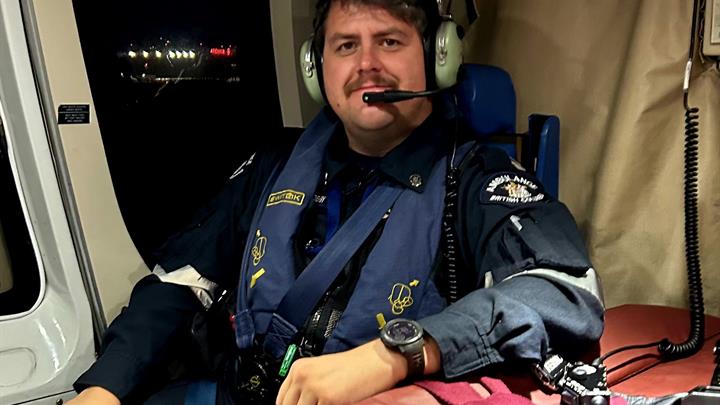
Primary Care Flight Paramedic Keira Evans started her BCEHS career as an emergency medical responder in Terrace in 2023. She was soon licensed as a primary care paramedic and started working at Station 580, the base for air operations in Prince George. Before the flight paramedic designation was created, she was already working on aircraft, as well as transporting patients to and from the air base by ground. With her new training and skillset, Keira is now better equipped to meet the needs of patients during air transfers and she’s also thinking about the next steps in her career as a paramedic.
“I knew I wanted to join the flight team pretty quickly, and this has given me a broader perspective on patient presentation and care. It also gives me a step up in terms of knowledge for further licensing. I will definitely pursue advanced care training, and I think it would be natural to progress to critical care after that. Working in the station with advanced care and critical care paramedics has already supported my growth as a medic.”
Jack Mulcahy’s first experience working in planes wasn’t at BCEHS – before becoming a paramedic, he was a smoke jumper, parachuting into remote areas to fight wildfires. He’s been a paramedic for six years now, starting as a primary care paramedic and then getting certified as an advanced care paramedic.
“This job gives you a unique view of healthcare as a whole,” he says of his work as an advanced care flight paramedic. “We’re stabilizing and then caring for patients as they move from their home communities to specialty centers and get the opportunity to be an intimate and critical part of their continuum of care.”
“The long and short of it is, it’s one of the best jobs out there.”